
Building on a site you already own
Home construction loan in Bangalore, released as your house rises
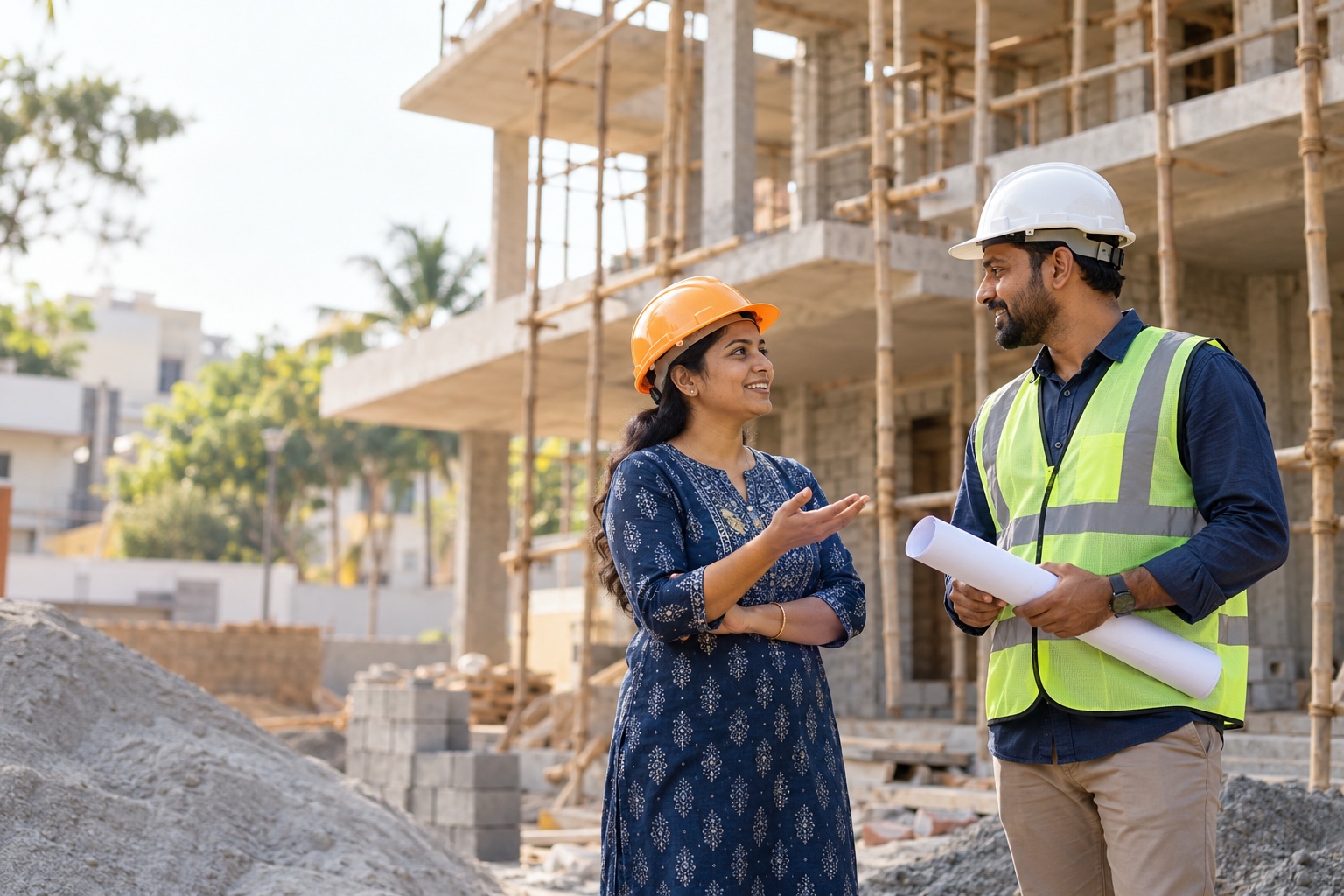
A home construction loan in Bangalore does not arrive as one cheque. The lender releases it in tranches as the building reaches agreed stages, after its engineer has seen the work. Plan your own funds, your builder's payment schedule and your pre-EMI around those stages and the build never stalls for money.
- Plinth
- Walls
- Roof
- Finishing
Own the site? Here is how the build gets funded
- Approved plan firstThe plan decides how much you can build, and so how much can be funded.
- Your share before theirsMany lenders expect your contribution on the site before the first release.
- Funds follow progressEach release comes after the lender's engineer sees the stage.
Construction loans are for people who already own a residential site and want to build on it. If you are buying the site too, a composite loan covers both. The lender looks at three things together: the land (title, Khata, approvals), the building you plan (approved plan and a realistic estimate), and you (income and credit history).
The amount is usually worked out on the construction estimate, and in many cases the value of the land you contribute is counted towards your share. Most lenders want to see some of your own money spent on the site first, then release their funds in stages.
Stage-wise disbursal
Follow the money: four stages, four site visits
Pick a stage to see what is released, what the engineer checks and what you pay each month while the house is being built. The split below is an example schedule; your sanction letter sets the real one.
Stage 1 of 4 · Plinth
Foundation and plinth beam
The first release comes once the footings and plinth are done. Many lenders expect your own contribution to have been spent on the site before they release anything.
- Released at this stage
- ₹8,00,000
- Released so far
- ₹8,00,000
- Your pre-EMI each month (interest only)
- ₹5,067/month
The lender's engineer checks
- Plinth footprint and setbacks match the approved building plan
- Your own contribution already spent on the work (bills, photos)
- Architect's or engineer's estimate and stage certificate
Monthly outgo: Plinth ₹5,067, Walls ₹12,667, Roof ₹20,267, Finishing ₹32,469.
01 Foundation and plinth beam
Example release: 20% of the loan, after the site visit.
- · Plinth footprint and setbacks match the approved building plan
- · Your own contribution already spent on the work (bills, photos)
- · Architect's or engineer's estimate and stage certificate
02 Columns, walls up to lintel
Example release: 30% of the loan, after the site visit.
- · Room layout and number of floors as per the sanctioned plan
- · Progress photos and a site visit by the lender's engineer
- · Bills for steel, cement and labour where the lender asks
03 Roof slab cast
Example release: 30% of the loan, after the site visit.
- · Roof slab completed for the approved number of floors only
- · No construction beyond the sanctioned built-up area
- · Updated valuation of the land and building so far
04 Plaster, flooring, doors, electricals
Example release: 20% of the loan, after the site visit.
- · Finishing work completed as per the estimate
- · Completion certificate or the architect's final certificate
- · Property tax and Khata updated for the new building, where the lender asks
Example schedule for illustration only. Lenders set their own stages and shares in the sanction letter; the full EMI here uses a 20-year tenure.
Pre-EMI or full EMI while you build?
Pre-EMI
You pay only the interest on the amount released so far. The monthly outgo starts small and rises with each tranche. Nothing goes towards the principal, so your loan term starts only after the final release.
Suits you if you are paying rent while building, or your cash is going into the construction itself.
Full EMI from the first release
You start paying the regular EMI on the released amount straight away, so the principal begins to reduce from month one. The monthly outgo is higher during construction, and the total interest is lower.
Suits you if your income comfortably covers it and you want the loan to finish sooner.
Before the sanction
What lenders check before a construction loan is sanctioned
The building does not exist yet, so the paperwork does the talking.
Title and Khata of the site
A clear title chain and an EC for the period asked, plus e‑Khata inside city corporation limits or e‑Swathu in panchayat areas. Some lenders consider B Khata sites; many don't.
An approved building plan
Sanctioned by the local planning authority for the number of floors you intend to build. Building more than the approved plan is the fastest way to lose the later tranches.
A realistic estimate
An architect's or civil engineer's cost estimate with built-up area and rate per square foot. Lenders compare it with their own idea of local construction costs.
Your income and existing EMIs
Your repayment capacity is assessed on the full loan, not on the first tranche, so your FOIR has to work for the final EMI.
Your own contribution
Proof that you can fund your share: land value, savings, and bills or photos of work already done.
The construction timeline
Lenders usually expect the house to be completed within a set period from the first release. Long gaps between tranches raise questions.
Documents for a construction loan on your own plot
Property papers are the same for everyone. The income set depends on how you earn.
Salaried
You and your income
- PAN card and Aadhaar (or passport / voter ID) for every applicant
- Last 3 to 6 months' salary slips
- Form 16 for the last 2 years
- 6 to 12 months' bank statement of the salary account
- Statements of any running loans, so existing EMIs are counted correctly
Site and building
- Sale deed of the site and the earlier title deeds
- Encumbrance certificate (EC) for the period the lender asks for
- Khata certificate and extract (e‑Khata) or e‑Swathu for panchayat areas
- Approved building plan and licence from the local authority
- Architect's or engineer's cost estimate with built-up area
- Latest land tax paid receipt
Self‑employed
You and your business
- PAN card and Aadhaar for every applicant, plus business PAN where relevant
- Income tax returns with computation of income for the last 2 to 3 years
- CA-certified profit & loss account and balance sheet for the same years
- 12 months' bank statements of the main current and savings accounts
- Proof the business has run continuously: GST registration, Udyam, trade licence or partnership deed
Site and building
- Sale deed of the site and the earlier title deeds
- Encumbrance certificate (EC)
- Khata certificate and extract, or e‑Swathu
- Approved building plan and licence
- Architect's or engineer's cost estimate
- Bills and photos of any work already completed
NRI
Building in Bengaluru while abroad usually needs someone you trust on site and a registered power of attorney for signatures.
You and your income
- Passport and visa / residence permit, plus the OCI card if you have one
- Overseas employment contract or appointment letter
- Last 3 to 6 months' salary slips (with an English translation if needed)
- 6 months' overseas bank statement where your salary is credited
- 6 months' NRE / NRO account statement in India
- Credit report from your country of residence, where the lender asks for it
Site and building
- All the site and plan documents in the salaried list
- Registered power of attorney in favour of the person managing the build
- Contractor agreement, if a contractor is building for you
Worked example · indicative
A ₹40 lakh construction loan at 7.6%
You build on your own site with a ₹40 lakh loan released in the example 20 / 30 / 30 / 20 split, choosing pre-EMI during construction.
- After plinth (₹8 lakh released)
- ₹5,067/month
- After walls (₹20 lakh released)
- ₹12,667/month
- After roof (₹32 lakh released)
- ₹20,267/month
- After finishing (full ₹40 lakh)
- Full EMI begins
- Full EMI over 20 years
- ₹32,469/month
Why construction loans stall between tranches
The first release is rarely the problem. The second and third are where files get stuck.
Building differs from the approved plan
An extra floor, a changed setback or a bigger built-up area than sanctioned. The engineer reports it and the next tranche is held.
What we do: Build to the sanctioned plan, or get a revised plan approved before you build differently.
Estimate far above the lender's own view
A premium finish or an unusually high rate per square foot. The lender sanctions less than you expected.
What we do: Get a detailed, itemised estimate from your engineer, and keep premium finishes in your own share.
Own contribution not visible
You paid the contractor in cash, so there is nothing to show the lender what you have spent.
What we do: Pay by bank transfer, keep bills and dated photos, and share them with the lender before each visit.
Long pause between stages
Work stopped for months and the lender wants to re-check the site, or the sanction is close to lapsing.
What we do: Plan your funds so work continues; if a pause is unavoidable, tell the lender in writing.
Site Khata or title issue found late
The site was bought years ago and its Khata or EC was never updated in your name.
What we do: Update the Khata and get a fresh EC before you apply. We check these first.
Construction loan questions we hear on site
Do I need to own the plot before applying for a construction loan?
Yes. A construction loan is for building on a residential site that is already registered in your name (or jointly with a co-applicant). If you are buying the plot and building on it, a composite plot + construction loan covers both.
How much construction loan can I get?
It is worked out on the approved construction estimate and your repayment capacity, and the lender funds a portion of the total cost according to RBI norms and its own policy. In many cases the value of the land you contribute counts towards your share. The final figure follows the lender's own valuation of the estimate.
Is the money paid to me or to the contractor?
It depends on the lender and on how you are building. Where a registered contractor has an agreement with you, many lenders pay the contractor directly against the stage. If you are building yourself, funds may come to your account against bills and the engineer's report.
What is pre-EMI and how long do I pay it?
Pre-EMI is the interest-only payment on the amount released so far. You pay it from the first release until the final tranche; after that, regular EMIs begin. You can usually choose to start full EMIs earlier if you want the principal to reduce sooner.
Can I get a construction loan on a B Khata site?
Some lenders do consider B Khata sites for construction, often with stricter checks or a lower amount; others don't at all. The plan approval and the layout's status matter as much as the Khata. Share the site documents and we will tell you honestly which lenders may consider it.
Can I use a construction loan to add a floor to my existing house?
Adding a floor is usually financed as a home extension or improvement loan rather than a fresh construction loan. The lender will still want an approved plan for the additional floor and will value the existing building too. Our home improvement loan page covers this.
Before you pour the plinth
Send us your approved plan and estimate. We'll map them to lenders.
Free for you: the eligibility check, comparing lenders, preparing your file and following up until disbursal cost you nothing, with no consultation fee and no file charge. The lender's own processing, legal and valuation fees are separate, and we tell you about them before you apply.
On WhatsApp, share photos of:
- · The site sale deed and Khata
- · The approved building plan
- · Your engineer's estimate
Open all 7 days, 10:00 AM – 7:00 PM. Figures on this page are indicative.