
Older properties · paper records
Manual Khata home loan in Bangalore, for homes with a paper past
A manual Khata home loan in Bangalore is usually about one thing: proving that decades of paper records agree with each other. We sort the folder, find the gaps a lender's lawyer will ask about, and help you move the record online so the loan can go ahead.
- Khata certificate
- Khata extract
- Tax receipts
What counts as a manual Khata?
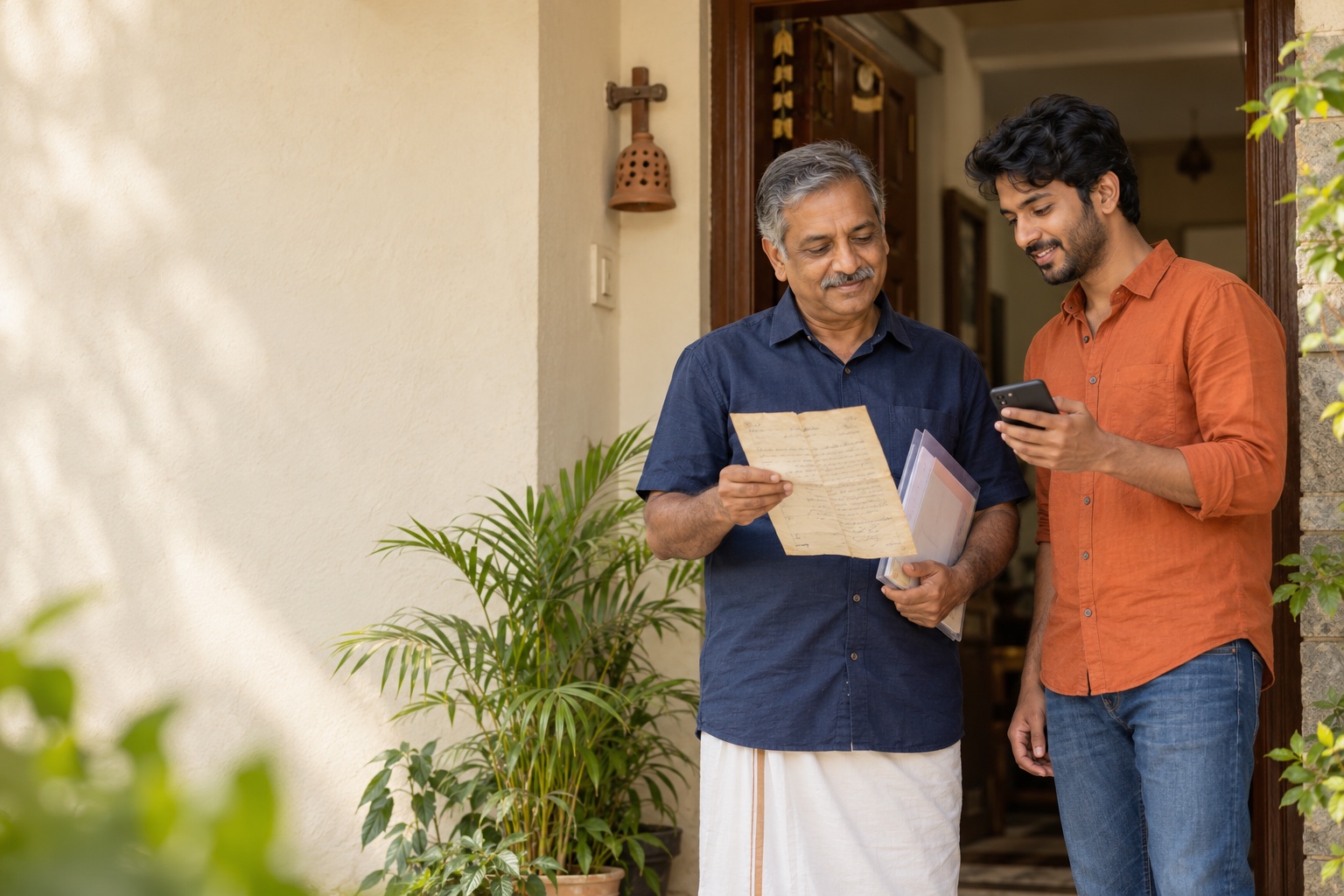
Before the e‑Khata system, the city's Khata records were written and issued by hand. Many older houses in established parts of Bengaluru still carry only those paper records: a Khata certificate, a Khata extract and a bundle of tax receipts, sometimes in a previous owner's name.
Nothing is wrong with the property because the record is old. The difficulty is verification. A lender's lawyer can check an e‑Khata online in minutes; a manual Khata has to be matched, by hand, against the sale deeds and the tax history. Where those agree, most of the work is already done.
Khata certificate
Confirms that the property is entered in the city's records in the owner's name. It is the document people usually mean by “the Khata”.
Khata extract
Gives the property's details from the register: measurements, location and tax assessment. Lenders ask for both.
Tick the papers in your folder
Manual Khata record match: which gaps will a lender ask about?
Tick what you hold, and the two checks underneath. The trail lights up as the chain fills, and the list on the right turns into the questions a lender's lawyer is likely to ask, with what to do about each.
Your paper trail
- 1: missingMother deed
- 2: missingLink deeds
- 3: missingSale deed
- 4: missingKhata
- 5: missingTax history
- 6: missinge‑Khata
Papers in your folder
Do they agree?
Record match
0 of 12
Start with the core papers. Without them, most lenders can't begin.
What a lender will ask, and what to do
“Where does the title start?”
Ask the seller or the family for the oldest deed; certified copies can be applied for at the sub-registrar's office.
“Is there a missing owner in the chain?”
List each owner in order and match it to a deed. A missing link needs a certified copy, or a legal explanation for an inheritance.
“Is the seller the registered owner today?”
Without it there is no loan. If the owner has died, the lender will ask for succession papers instead.
“Is the property in the city's records in the owner's name?”
Find the latest certificate, or apply for a fresh one in the current owner's name.
“Do the register details match the deed?”
Get a current extract and check the measurements and location against the deed's schedule.
“Is the tax paid up to date?”
Pay any arrears and keep the receipts; lenders read gaps in tax as gaps in the record.
“Is the property free of any loan or charge?”
Apply for an EC covering the years your lender asks for, and check every entry is explained.
“Was the building approved, and does it match?”
Look for the original plan copy. If there was none, expect the valuer to look harder at the structure.
“Does the utility record agree with the owner?”
A bill in an old owner's name is common. Note it; transfer it if you can before the loan.
“Has the record moved online yet?”
Apply for the e‑Khata now. Most lenders inside city limits want it before disbursal.
“Why do the names differ?”
Get an affidavit or correction for the difference before the lawyer finds it.
“Which measurement is correct?”
Ask a surveyor or the lender's valuer early; small differences need a written explanation.
A guide to likely questions, not a legal opinion. Each lender’s lawyer decides what they need.
Read from oldest to newest
The paper trail a lender reads on an older property
On a manual Khata file the lawyer starts at the oldest document and walks forward. Knowing the order helps you see where your folder is thin.
- 01
Mother deed
The earliest document that shows how the land or house first came to an owner.
- 02
Link deeds
Every sale, gift or partition since, so the chain of owners has no gap.
- 03
Current sale deed
The deed in the seller's name, and later in yours.
- 04
Khata certificate and extract
The city's record of the property, its owner and its measurements.
- 05
Tax receipts and EC
Proof that tax is paid and that no loan or charge is registered against it.
- 06
e‑Khata
The digital record. Once it is in place, the old papers stop being the only proof.
Getting the record online
Moving a manual Khata to e‑Khata
You don't need to finish this before you speak to a lender, but you should start it. The e‑Khata is what most lenders inside city limits want to see before they disburse.
If the e‑Khata comes back as B Khata, the loan is still often possible; it just goes to a different set of lenders. See the B Khata route
- 1
Put the old papers in order
Khata certificate, extract, tax receipts and the registered deed, all in the current owner's name where possible.
- 2
Check the details agree
Names and measurements should match across every paper. Fix differences first; they are the usual reason an application pauses.
- 3
Apply for the e‑Khata
Through the city corporation's official e‑Khata service, with the owner's e‑KYC, deed details, tax ID and electricity account number.
- 4
Check the result
When it arrives, read it against the deed: owner name, area, and whether it shows A or B Khata.
When a manual Khata file goes smoothly, and when it doesn't
Usually smooth
- An older house with an unbroken chain of deeds
- Tax paid every year, receipts kept
- Names and measurements that agree across papers
- The e‑Khata already applied for
Expect more questions
- An owner who has died, with no succession papers yet
- Deeds missing from the middle of the chain
- A Khata still in a previous owner's name
- Additions to the building with no sanctioned plan
Older properties with paper records are common in established parts of the city. Local notes: Rajajinagar, JP Nagar, South Bengaluru.
Manual Khata questions, answered
Can I get a home loan on a property with a manual Khata?
Often, yes, once the paper records agree with each other. Most lenders inside city limits will also want the e‑Khata, or at least the application, before disbursal. Send us what you have and we tell you where the file stands.
What is the difference between a Khata certificate and a Khata extract?
The certificate confirms the property is in the city's records in the owner's name. The extract gives the details from the register, such as measurements and the tax assessment. Lenders usually ask for both.
The manual Khata is still in the previous owner's name. Is that a problem?
It is a question a lender will ask. The Khata should be transferred to the current owner on the strength of the registered deed. Start that before you apply, and keep the acknowledgement.
Do I really need the mother deed for a home loan?
Most lenders want to see the title from its start, so yes, usually. If it can't be found, a certified copy can be applied for, and the lender's lawyer may accept other evidence for very old titles. We tell you what your lender is likely to ask for.
I inherited the house and the papers are old. Can I take a loan against it?
Yes, through a home loan, top-up or loan against property, once the succession is on record. The lender will ask for the death certificate, legal heir or succession papers, and the Khata transferred to the heirs.
Does a manual Khata make the loan slower?
A little, because the legal check is done by hand. What really slows it down is a missing deed or a name mismatch, which is why we look for those first.
Bring the old file. We'll sort it with you.
Old records are easier to read across a table. Visit us in Jayanagar with the folder, or leave your details and we call you first.
No. 62, The High Street, 11th Main Road, Jayanagar 4th Block, Jayanagar, Bengaluru 560011Open all 7 days, 10:00 AM – 7:00 PMFree for you: the eligibility check, the lender comparison, file preparation and follow-up until disbursal. Lenders still charge their own processing, legal and valuation fees, and we tell you these before you apply.
Or we call you first
Four details, and our expert calls during office hours to go through your papers.